You're standing at the mirror with two serums in your hands. One's your copper peptide serum. The other's your vitamin C. Both are meant to be doing serious work on your skin — so the obvious move is to layer them and double up, right?
Not so fast. This is one of the most common questions in skincare, and also one of the most commonly botched. Used together the wrong way, copper peptides and vitamin C can quietly cancel each other out — leaving you with two expensive serums doing the work of neither.
Here's the honest, no-jargon answer: yes, you can use both — but not at the same moment, and the details matter.Let's break it down so you actually get the benefit you paid for.
The short answer
You can absolutely have both copper peptides and vitamin C in your routine. What you shouldn't do is apply them layered directly on top of each other in the same sitting.
The simplest, foolproof approach: vitamin C in the morning, copper peptide serum at night. That's it. If you only remember one thing from this article, remember that.
If you want them closer together than that, there are ways — and we'll cover them — but they come with conditions. Read on before you start mixing.
Why copper peptides and vitamin C clash
It comes down to basic chemistry, and you don't need a science degree to follow it.
Pure vitamin C — the most common and most active form, L-ascorbic acid — is acidic and a bit temperamental. It works best in a low-pH (acidic) environment. Copper peptides like GHK-Cu prefer a more neutral environment.
When you apply them together, two things go wrong. First, the copper ion speeds up vitamin C's breakdown — copper acts as a catalyst that makes vitamin C oxidise faster, the same browning reaction you see when a cut apple goes off. Your vitamin C degrades before it can work. Second, the reaction can blunt the copper peptide too — it doesn't just damage the vitamin C, it can interfere with the peptide's ability to do its job as well.
So instead of two powerhouse actives, you get two weakened ones — and on sensitive skin, the combination can also tip into irritation. That's the worst of both worlds: less result, more redness.
How to use both — three ways that actually work
Option 1: Split by time of day (the easy win). Vitamin C in the morning, copper peptides at night. Vitamin C's antioxidant protection is genuinely more useful in the daytime anyway — it helps defend against sun and pollution — and copper peptides suit the evening, when your skin does most of its natural repair. This is foolproof and it's what we recommend for most people.
Option 2: Alternate days. If your skin is on the sensitive side, or your formulas are particularly strong, go even safer: vitamin C one day, copper peptides the next. Both still get their turn, with zero chance of interaction.
Option 3: Same routine, with a gap (the advanced play). Want both in the same session? Apply your vitamin C first, then wait 10–15 minutes — until your skin is fully dry and the vitamin C has absorbed — before applying your copper peptide serum. The gap lets your skin's pH settle and minimises the surface reaction. This works, but it's the fiddliest option and the easiest to rush. If you're impatient, stick with Option 1.
The shortcut most people don't know about
Here's the nuance the hype articles skip: not all vitamin C is created equal, and some forms don't clash with copper peptides at all.
The conflict above is specifically about pure L-ascorbic acid — the strongest but least stable form. But vitamin C comes in gentler, more stable "derivative" forms, such as Tetrahexyldecyl Ascorbate (THD Ascorbate) or sodium ascorbyl phosphate. These are oil-soluble or pH-neutral, far more stable, and play nicely with copper peptides.
If your vitamin C serum uses one of these derivatives, you can largely throw the timing worries out the window and layer with much less concern. So before you build a complicated schedule around your two serums, check the ingredients list on your vitamin C. If it's L-ascorbic acid, follow the rules above. If it's a derivative, you've got far more flexibility.
This is exactly why reading labels — and buying from brands that are clear about what's actually in the bottle — matters more than following generic rules.
A few extra tips to get it right
Patch test first — any time you combine actives, test on a small area (behind the ear or inner arm) for a day or two before going all-in on your face. Don't over-stack — copper peptides, vitamin C, retinol and strong acids all at once is a recipe for an irritated, compromised skin barrier, not faster results; add one active at a time and let your skin adjust. Always finish with SPF in the morning — whatever you layer, sunscreen is the step that actually protects all that anti-ageing work. And give it time — copper peptides work gradually, so think 8–12 weeks of consistency, not days.
The bottom line
Can you use copper peptides and vitamin C together? Yes — they're both excellent, and there's no reason to pick just one. You just can't slap them on top of each other and expect both to survive.
Keep it simple: vitamin C in the morning, copper peptides at night. Check whether your vitamin C is L-ascorbic acid (follow the timing rules) or a gentler derivative (relax, you've got flexibility). And give the routine a couple of months before you judge it.
Do that, and you get the full benefit of two of the best-researched anti-ageing ingredients in skincare — instead of two half-working serums and a confused complexion.
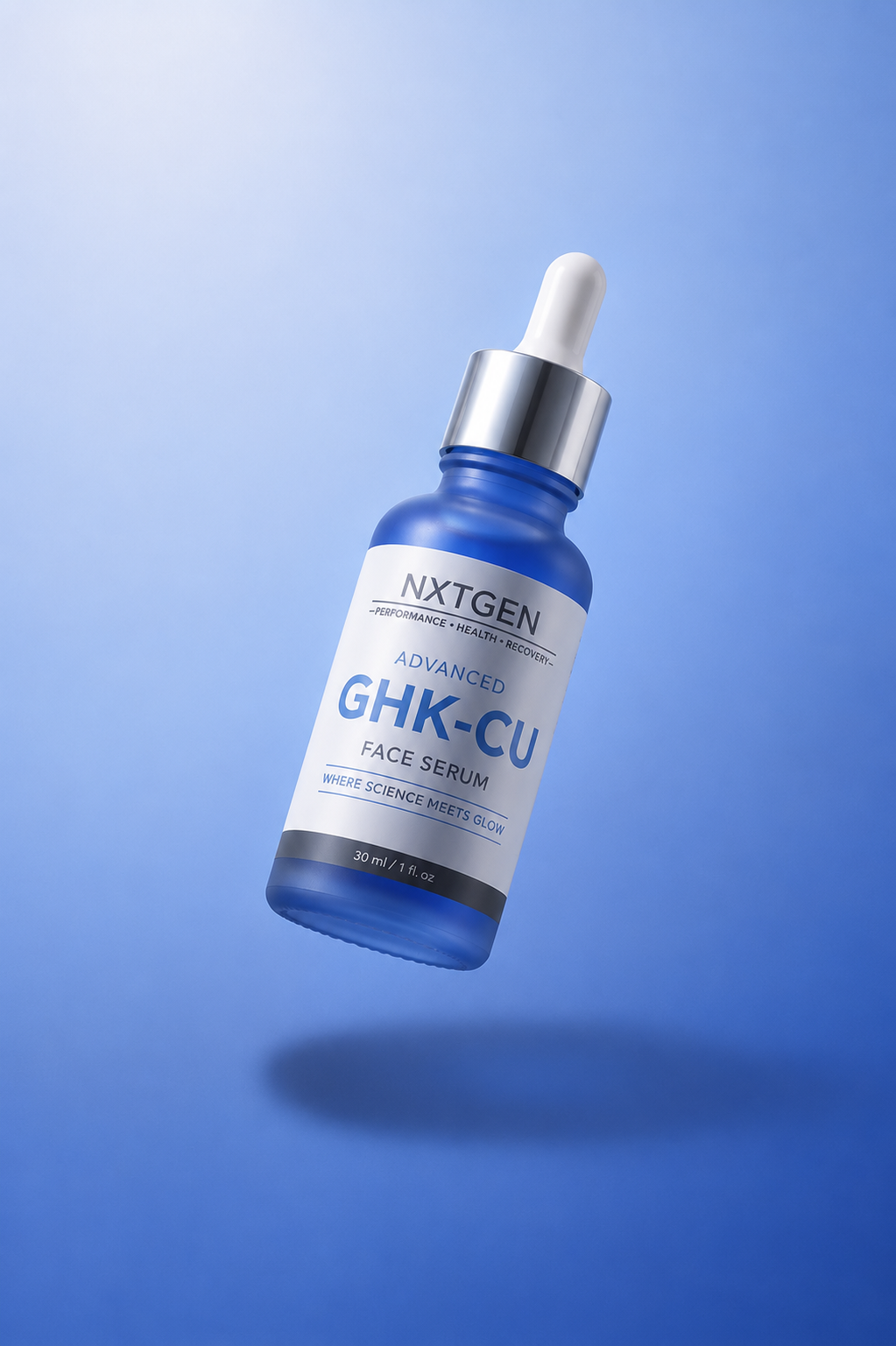
Building your copper peptide routine? The NXTGEN GHK-Cu Advanced Peptide Serum is full-dose, small-batch, and made in our WA lab — formulated to slot cleanly into a smart routine. Shop the serum.
New to copper peptides? Start with our guide: What GHK-Cu actually does for your skin.
This article is general information about skincare ingredients and is not medical advice. Individual results vary. If you have a skin condition or concerns, consult a healthcare professional.